Table of Contents >> Show >> Hide
- What exactly is an ultrasound scan?
- The science behind ultrasound imaging
- Step-by-step: what happens during an ultrasound scan?
- Different types of ultrasound scans
- Benefits of ultrasound imaging
- Limitations: when ultrasound isn’t the best choice
- Is ultrasound safe?
- How to prepare for your ultrasound scan
- Making sense of your ultrasound report
- Real-life experiences: what an ultrasound scan actually feels like
- The bottom line
If you’ve ever seen a grainy black-and-white image of a baby kicking on a screen, stared at a monitor while a tech said “take a deep breath and hold,” or listened to a whooshing heartbeat through speakers, you’ve already met ultrasound. Ultrasound scans are everywhere in modern medicine, from pregnancy checkups to heart exams – but what’s actually happening under all that cold gel and clicking buttons?
In simple terms, an ultrasound scan uses high-frequency sound waves, not radiation, to create pictures of the inside of your body in real time. It’s a bit like medical echolocation: the machine sends sound into your body, listens to the echoes, and turns those echoes into images that doctors can interpret. Safe, fast, and surprisingly high-tech, ultrasound has become one of the most commonly used imaging tools in hospitals and clinics.
Let’s break down how ultrasound scans work, why the gel is always freezing, what you can expect during a scan, and how to make sense of the results – all in plain English.
What exactly is an ultrasound scan?
An ultrasound scan, also called ultrasonography or a sonogram, is an imaging test that uses sound waves to create pictures of organs, tissues, blood vessels, and other structures inside your body. Unlike X-rays or CT scans, ultrasound doesn’t use ionizing radiation, which is one reason it’s considered very safe for people of all ages, including pregnant individuals and children.
Ultrasound scans are used to:
- Check on a developing baby during pregnancy.
- Look at abdominal organs like the liver, gallbladder, pancreas, kidneys, and spleen.
- Evaluate the heart (an echocardiogram).
- Assess blood flow in arteries and veins using Doppler ultrasound.
- Examine soft tissues, muscles, tendons, thyroid, and more.
- Guide procedures, such as needle biopsies or fluid drainage.
In other words, if it’s soft, squishy, and important, there’s a good chance ultrasound can help visualize it.
The science behind ultrasound imaging
From electricity to sound and back again
The heart of the system is a handheld device called a transducer or probe. Inside the transducer are tiny crystals made from a material with a special property called the piezoelectric effect. When electricity passes through these crystals, they vibrate and produce high-frequency sound waves – typically in the range of 2 to 20 megahertz, far above what human ears can hear.
Here’s the basic loop:
- The ultrasound machine sends an electrical signal to the transducer.
- The crystals in the transducer vibrate and emit sound waves into your body.
- Those sound waves travel through your tissues.
- Whenever they hit a boundary between different tissues (for example, fluid and organ, organ and fat), some of the sound bounces back as an echo.
- The same crystals switch into “microphone mode” and pick up the returning echoes.
- The machine’s computer measures how long the echoes took to return and how strong they are, then turns that information into an image on the screen.
The result is a real-time, moving picture – think “live video” rather than a single snapshot. This is why ultrasound is great for watching a beating heart, tracking blood flow, or watching a baby wiggle.
Why the gooey gel matters
About that gel: it isn’t just there to make you mildly uncomfortable. Sound doesn’t travel well through air, and even a thin layer of air between the transducer and your skin can distort or block the sound waves. The ultrasound gel fills in tiny air gaps and helps sound waves pass smoothly from the transducer into your body and back again, which improves image quality significantly.
In short: no gel, no good images. That’s why they use a generous amount – and why you might feel like someone just squeezed half a bottle of cold jelly onto your stomach.
Step-by-step: what happens during an ultrasound scan?
Before the scan: preparation
Preparation varies depending on what part of your body is being examined:
- Abdominal ultrasound: You may be asked not to eat or drink for 8 to 12 hours before the test to reduce gas in your intestines, which can interfere with the sound waves.
- Pelvic or pregnancy ultrasound: Sometimes you’ll be asked to drink several glasses of water and not use the restroom right away. A full bladder pushes the bowel out of the way and acts like a “window,” helping the sound waves travel better.
- Other exams: Many ultrasound tests require little or no special preparation. You may just be asked to wear loose, comfortable clothing and remove jewelry from the area being scanned.
Your healthcare team will give you specific instructions, and it’s important to follow them – good prep often means better images and fewer repeat scans.
During the scan
Most ultrasound exams follow the same general pattern:
- You’ll lie on an exam table, usually on your back or side, depending on the area being scanned.
- The sonographer (the trained ultrasound technologist) applies gel to your skin.
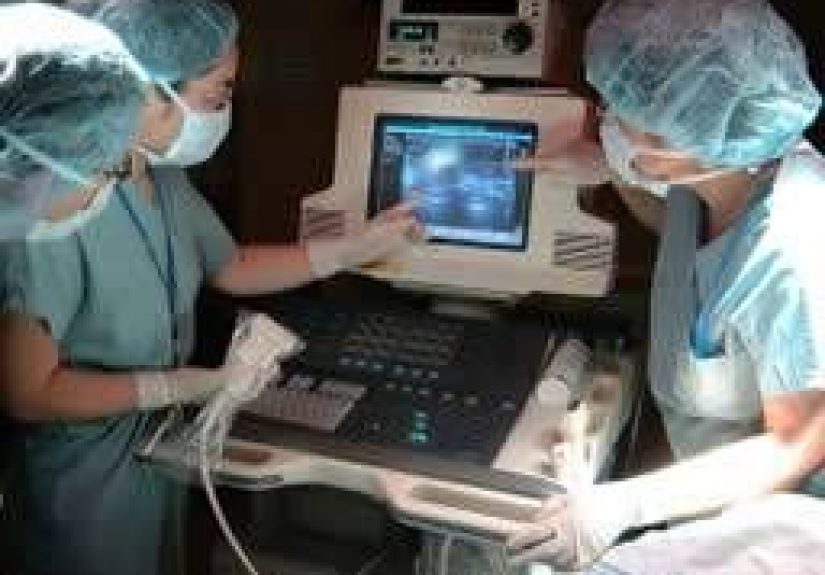
- They press and move the transducer over the area of interest, sometimes asking you to hold your breath, roll to one side, or change positions.
- The machine displays moving images on the screen. The sonographer may capture still images or video clips and make measurements.
- You might hear whooshing sounds during a Doppler ultrasound, which is the sound of blood flow converted into audio.
Most scans take 15 to 45 minutes and are painless, though you might feel pressure from the probe, especially over a tender area or a very full bladder.
After the scan
When the exam is done, the sonographer wipes off the gel (you may still discover a stray spot or two later), and you can usually return to normal activities right away. A doctor trained in interpreting imaging studies – often a radiologist or a cardiologist – reviews the images and writes a report for the provider who ordered the test.
Different types of ultrasound scans
2D, 3D, and 4D ultrasound
The classic black-and-white ultrasound you’ve seen is a 2D ultrasound, which shows flat, cross-sectional slices of the body. Newer technologies can reconstruct this data into:
- 3D ultrasound: Produces three-dimensional images, often used in pregnancy to visualize the baby’s face or body in more detail.
- 4D ultrasound: Essentially 3D images in motion, like a live video of the 3D view.
These advanced modes are fun to look at, but their use is still primarily medical: they can help clarify the shape of organs, detect certain abnormalities, or better visualize complex anatomy.
Doppler ultrasound: tracking blood flow
Doppler ultrasound uses the Doppler effect – changes in the frequency of sound waves when they reflect off moving objects – to measure and visualize blood flow. It can show the speed and direction of blood in vessels and help detect:
- Narrowed or blocked arteries.
- Blood clots in veins.
- Abnormal blood flow patterns in the heart or organs.
This is especially important in conditions like peripheral artery disease, deep vein thrombosis, or heart valve problems.
Common areas examined with ultrasound
Ultrasound isn’t just for pregnancy. Common exam types include:
- Obstetric ultrasound: Checks fetal growth, movement, and anatomy during pregnancy.
- Abdominal ultrasound: Looks at organs such as the liver, gallbladder, pancreas, kidneys, and major blood vessels.
- Pelvic ultrasound: Evaluates the uterus, ovaries, prostate, and bladder.
- Echocardiogram: Assesses the heart’s chambers, valves, and pumping function.
- Vascular ultrasound: Examines arteries and veins in the neck, arms, and legs.
- Musculoskeletal ultrasound: Looks at muscles, tendons, ligaments, and joints.
- Thyroid and neck ultrasound: Evaluates nodules, glands, and lymph nodes.
Because ultrasound can be portable, it’s also widely used in emergency rooms, intensive care units, and clinics as a rapid, bedside imaging tool.
Benefits of ultrasound imaging
Ultrasound has become a go-to imaging option for many reasons:
- No ionizing radiation: Unlike X-rays and CT scans, ultrasound uses sound waves, making it a safer choice for frequent imaging and during pregnancy.
- Real-time imaging: Providers can see structures move as they work, which is ideal for guiding procedures or evaluating motion (like heartbeats or joint movement).
- Noninvasive and generally painless: No incisions or injections are needed for most exams.
- Widely available and relatively affordable: Ultrasound machines are more common and less expensive than many other imaging devices.
- Portable: Smaller machines can be used at the bedside, in clinics, or even in ambulances in some settings.
Limitations: when ultrasound isn’t the best choice
As useful as it is, ultrasound isn’t perfect. Its main limitations include:
- Air and gas get in the way: Ultrasound waves do not travel well through air, so bowel gas or air in the lungs can block or distort images. That’s why some abdominal or chest conditions are better evaluated with CT or X-ray.
- Bone is a barrier: Ultrasound can’t see through bone, so it’s not the best tool for imaging deep structures inside the skull or spine. It can, however, look at surfaces of bones or fluid around them.
- Image quality depends on the operator: Ultrasound is very “user dependent.” The skill and experience of the sonographer and interpreting doctor matter a lot.
- Body habitus matters: In some people, especially those with a higher body mass index, sound waves may not penetrate as deeply or clearly, which can lower image quality.
When ultrasound can’t answer the question, your provider may recommend other imaging tests, such as MRI or CT.
Is ultrasound safe?
Ultrasound is considered a very safe imaging method when used appropriately. It uses non-ionizing sound waves, not radiation, and has been used in medicine for decades. Regulatory agencies like the U.S. Food and Drug Administration (FDA) set limits on the energy output of diagnostic ultrasound machines and require manufacturers to meet strict safety standards.
In routine diagnostic use, no harmful long-term effects have been confirmed in humans. Still, the guiding principle is “as low as reasonably achievable” (ALARA) – meaning providers use the lowest energy settings and shortest scan time that can still provide good images.
One important note: keepsake or non-medical ultrasounds done purely for fun, without a medical reason or qualified supervision, are generally discouraged by major medical organizations. If you’re getting scanned, it should be for a clear clinical purpose and performed by trained professionals.
How to prepare for your ultrasound scan
To get the most accurate results (and the least stress), keep these tips in mind:
- Follow instructions closely: If you’re told to fast or drink water, there is a technical reason for it, not just a random challenge.
- Wear comfortable clothing: You may be asked to change into a gown or expose the area being scanned, so simple, loose clothing helps.
- Bring a list of medications and health conditions: This can help the sonographer and doctor understand the bigger picture.
- Ask questions: It’s absolutely okay to ask what the sonographer is looking at or what certain noises mean – just know they usually can’t give you a final diagnosis on the spot.
- Plan a little extra time: Check-in, the scan itself, and any waiting afterward can take longer than expected.
Making sense of your ultrasound report
After your scan, a physician trained in imaging reviews the pictures and writes a report. Here’s how to think about it:
- Sonographer vs. doctor: The sonographer is highly skilled at obtaining images, but the interpreting doctor (such as a radiologist) typically makes the official diagnosis.
- Technical language: Your report might include terms like “hypoechoic,” “cystic,” or “no sonographic evidence of x.” Don’t panic if it sounds intense – ask your provider to translate it into everyday language.
- Next steps: An ultrasound may answer the question completely, or it may suggest further tests or follow-up scans. Your provider will walk you through what it means for your specific situation.
Real-life experiences: what an ultrasound scan actually feels like
Reading about ultrasound physics is one thing. Actually lying on the exam table with gel on your skin is another. While everyone’s experience is unique, there are some common themes people share when they talk about ultrasound scans.
First, most people are surprised by how routine it feels. You check in, answer a few questions, and are led into a dimly lit room that looks more like a small office than a sci-fi lab. There’s a padded table, a monitor on an adjustable arm, and a cart with the ultrasound machine. It’s not as noisy or intimidating as an MRI or as bright as an X-ray suite.
Then comes the legendary gel. It’s usually clear or slightly blue, and depending on the clinic, it might be warmed (if you’re lucky) or cool (if you’re less lucky). When the sonographer spreads it on, it can feel a bit like someone drawing on your skin with a cold, slippery marker. It’s not painful, just… noticeable. Many people say the gel is the weirdest part of the whole test.
As the scan begins, you’ll feel the transducer gliding over your skin with varying levels of pressure. Over most areas, it just feels like firm touch, but over a sore spot or a very full bladder, it can be a bit uncomfortable. The sonographer may ask you to turn on your side, hold your breath for a few seconds, or take a deep breath and hold it. These maneuvers help move organs or structures into better view, kind of like adjusting the angle of a selfie to find better lighting.
If you’re having a pregnancy ultrasound, you might be focused on the screen, waiting to see a tiny flickering heartbeat or the outline of a face. Many people describe these scans as emotional milestones – moments when the pregnancy suddenly feels very “real.” You might hear terms like “crown-rump length” or “gestational age” as measurements are taken. Occasionally, there’s a pause while the sonographer concentrates; that can feel nerve-wracking, but it often just means they’re capturing precise images or measurements.
With a Doppler ultrasound, especially for vessels or the heart, you might hear that characteristic “whoosh-whoosh” sound. That’s blood flow being transformed into audible sound. Some people joke that it sounds like a washing machine or distant thunder, but to a clinician, those patterns carry valuable information about the health of your heart and vessels.
People who’ve had multiple ultrasound scans often comment on how interactive the experience can be. Depending on the setting, the sonographer may point out structures on the screen: “Here’s your liver; this is your kidney; this bright line is bone.” You may not become an overnight anatomy expert, but seeing your own organs in real time is surprisingly fascinating – and sometimes reassuring.
The emotional side of ultrasound is real, too. Waiting for results can be stressful, especially if the scan is being done to check for a suspected problem. It helps to remember that ultrasound is just one tool your care team uses to understand what’s going on and to guide the next steps in your care. Bringing a support person, writing down your questions ahead of time, and asking your provider to walk through the report with you can all make the experience feel less overwhelming.
Finally, once the scan is over, there’s the cleanup phase. The sonographer wipes off most of the gel, but don’t be surprised if you find a stray patch later on your shirt or belly. Consider it a souvenir from your brief adventure in medical physics.
Overall, most people find ultrasound exams to be quick, low-stress, and far less intimidating than they expected. You get high-tech insights into what’s happening inside your body, but the test itself requires nothing more dramatic than lying still, following simple instructions, and putting up with a bit of slippery gel.
The bottom line
Ultrasound scans are a powerful blend of simple physics and sophisticated technology. By using high-frequency sound waves and sensitive detectors, they create real-time images that help clinicians diagnose conditions, monitor pregnancies, and guide procedures – all without exposing you to ionizing radiation. While there are limitations and it isn’t the right tool for every situation, ultrasound remains one of the safest, most versatile, and most accessible imaging options in modern medicine.
The next time you see an ultrasound image, you’ll know there’s a lot more going on than fuzzy gray shapes – behind those pixels is a precise dance of sound waves, echoes, and clever engineering, all working quietly in the background to keep you healthy.