Table of Contents >> Show >> Hide
- Why Pool Noodles Work (And Why They’re Better Than Random Towels)
- Quick Supply List
- Bike Protection: The Pool Noodle Projects That Actually Save Paint
- Monitor Protection: Keep Your Screen From Becoming a Very Expensive Stress Test
- Cutting, Attaching, and Not Making a Sticky Mess
- Mistakes to Avoid (So This Hack Doesn’t Become a “Hack” in the bad way)
- When to Upgrade Beyond Pool Noodles
- Real-World Experiences and Scenarios (The 500-Word “Yep, That Happened” Section)
Pool noodles have one job descriptionfloaty friendand yet they keep showing up in garages, moving boxes, and home offices like they pay rent.
They’re cheap, lightweight, easy to cut, and surprisingly good at one thing grown-ups never stop needing: preventing expensive stuff from getting dinged, scratched, or bumped.
In this guide, you’ll learn smart, practical ways to repurpose pool noodles to protect two things that tend to suffer quietly until one day they don’t:
bikes (paint, frames, and components) and computer monitors (screens, corners, stands, and sanity).
The vibe is “budget-friendly gear insurance,” not “arts-and-crafts chaos.”
Why Pool Noodles Work (And Why They’re Better Than Random Towels)
A pool noodle is basically a long cylinder of squishy foam that compresses on impact and springs back. That’s the magic:
it absorbs little knocks before those knocks turn into chips, scuffs, bent brackets, or cracked screens.
Unlike towels, noodles keep their shape, don’t slip as easily, and create a consistent cushion where you need it.
- They’re cuttable: slice them into sleeves, rings, bumpers, and corner guards.
- They’re grippy: the foam “hugs” edges and tubes when cut with a slit.
- They’re replaceable: when one gets crushed, sun-baked, or gross, you toss it without a funeral.
Quick Supply List
You can do most of these projects with basic stuff. If you’re under 18, get an adult to help with any cutting, drilling, or sharp tools.
Fingers are not optional accessories.
- Pool noodles (standard size is fine; denser foam feels sturdier)
- Hook-and-loop straps (Velcro-style) or zip ties
- Painter’s tape (temporary holds) and/or gaffer tape (cleaner removal than duct tape)
- Microfiber cloths (great as a “soft layer” between foam and paint/screen)
- Scissors (for straps) and a measuring tape/marker
- A cutting board or thick cardboard as a safe cutting surface
- Optional: washers + screws (for mounting bumpers on walls/boards)
Bike Protection: The Pool Noodle Projects That Actually Save Paint
1) Pad a Bike Rack So Frames Don’t Rub and Rattle
Bike racks are helpful, but straps and metal arms can create frictionespecially on long drives or bumpy roads.
The goal is to add cushioning where bikes contact the rack and where bikes might contact each other.
-
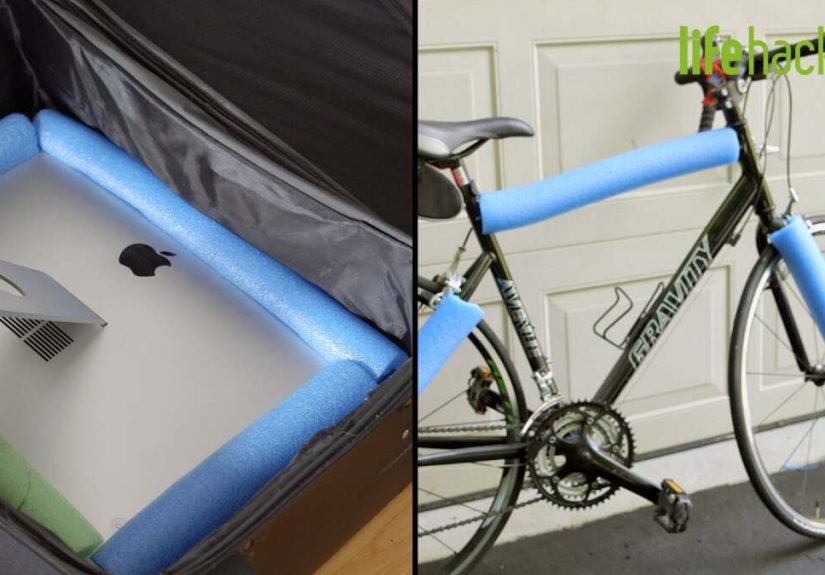
Make “rack sleeves”: cut a noodle section to match the rack arm length. Cut a slit along one side so it can open like a taco.
Press it over the rack arm where the frame rests. -
Secure it: use hook-and-loop straps or zip ties at both ends (and one in the middle if it wiggles).
Don’t over-tightenjust snug enough to stop sliding. -
Add “anti-bang spacers”: cut 1–2 inch rings (little foam donuts). Slide them onto rack arms between bikes
so handlebars and top tubes aren’t constantly trying to become best friends.
Pro tip: If you’re worried about foam residue or heat, add a microfiber cloth layer between the noodle and the bike’s paint,
then strap everything together. It’s like putting a soft T-shirt on your bike before it rides shotgun.
2) Protect Forks, Stays, and “Pointy Bits” During Travel or Storage
When bikes sit close togetheron a rack, in a car trunk, in a crowded garagetiny contact points do the most damage.
Fork legs, chainstays, and seatstays often take the hit.
- Fork-leg guards: cut short noodle segments and slit them open; wrap around fork legs or suspension stanchion areas (not seals).
- Frame tube bumpers: add foam to top tube/down tube areas that tend to contact another bike or a rack strap.
- Pedal/axle “no-poke zones”: use small foam pieces to block sharp ends from pressing into another bike’s frame.
If you’re packing a bike for travel, think like a shipping company: any part that could knock another part should get a cushion in between.
A pool noodle is essentially “foam padding you can customize.”
3) Turn Your Garage Into a No-Ding Zone
Bikes get damaged at home in the most dramatic way possible: quietly, while you’re not looking. A handlebar clips the wall.
A pedal taps a shelf leg. A frame leans into something sharp. Boommystery scratch.
Try these garage-friendly upgrades:
-
Wall bumper at bike height: mount a half noodle horizontally on the wall where handlebars or pedals might touch.
(If you mount it, use washers so screws don’t tear through the foam.) - Ceiling hook padding: if you hang bikes, wrap noodle pieces around hooks or the contact points where rims rest.
- Shelf-edge guards: slit a noodle and press it onto sharp shelf edges near where bikes lean or roll.
4) Protect Bikes While You Work on Them
Repairs and cleaning sessions are sneakily dangerous. Bikes shift. Tools bump tubes. The bike stand clamp pinches where it shouldn’t.
A small noodle strip can protect contact points while you wrench.
- Slip a thin foam strip over a stand arm where the bike rests.
- Add foam to the edge of a workbench near the bike’s frame.
- Use a foam ring as a “buffer” where cables might rub against a frame in storage.
5) The “Pool Noodle Bike Hack” (Worth Mentioning, With Context)
You may have seen cyclists strap a pool noodle horizontally to a bike so it sticks out into the road.
The idea is to encourage drivers to give more space. It’s a viral hack, but it’s not a replacement for safe infrastructure,
and it can be awkward in tight spaces. If you try it, keep it short, visible, and legal where you liveand don’t use it as an excuse to take risks.
Monitor Protection: Keep Your Screen From Becoming a Very Expensive Stress Test
1) A Simple “Monitor Bumper” for Tight Desks
If your desk is pushed against a wall, your monitor is one accidental shove away from a corner tap.
A pool noodle can act like a soft stop.
- Wall bumper: mount a noodle strip on the wall behind the monitor at the height where the monitor would hit.
- Desk-edge cushion: slit a noodle and press it along the back edge of the desk so the monitor stand can’t slam into the hard edge.
- Cable “spine” protector: place a noodle segment where cables bend sharply, so they’re guided gently instead of kinked.
2) DIY Corner Protection for Moving (Without Fancy Foam Kits)
Monitor corners are vulnerableone drop or sideways bump can crack plastic or stress the panel.
Moving kits often use foam corners that suspend the screen away from the box walls.
You can mimic that idea with pool noodles.
- Create corner “L” guards: cut four equal noodle pieces (about 8–10 inches). Make a slit in each piece.
- Wrap each corner: position each piece so it grips the monitor corner like a padded brace.
- Hold in place: use hook-and-loop straps around the monitor (not across the screen) or wrap the whole thing in a moving blanket.
- Box it upright: if you have the original box, use it. If not, use a snug box and add padding so the monitor can’t slide.
Important: Keep monitors upright during transport when possible, avoid stacking heavy items on them, and keep the screen from rubbing anything abrasive.
Think “no pressure on the panel.” Monitors don’t like being used as furniture.
3) Make a Screen-Safe Protective Layer (No Tape on the Display, Please)
If you’re moving or storing a monitor, a soft layer directly over the screen helps prevent micro-scratches.
The safest approach is a clean microfiber cloth over the screen, then a rigid layer like cardboard over that, then your outer padding.
- Lay a clean microfiber cloth on the screen (no grit, no crumbs, no “mystery glitter”).
- Add a cardboard sheet cut to monitor size to protect against pokes and bending.
- Wrap the whole monitor in a blanket or bubble wrap, then add noodle corner guards.
4) A Quick Carry/Storage “Cradle” for Smaller Monitors
For smaller monitors (and especially portable monitors), you can make a simple foam cradle in a tote:
- Line the tote sides with slit noodle strips so the monitor sits centered.
- Add a towel at the bottom for cushion.
- Place the monitor upright, screen facing inward toward the softest area.
- Fill empty space with soft items so it can’t tip or slide.
Cutting, Attaching, and Not Making a Sticky Mess
Cutting Tips
- Mark your cuts first so pieces match (especially corner guards).
- Cut on a stable surface like a cutting board or thick cardboard.
- If you’re new to DIY, ask an adult for help with blades. Slow beats rushed every time.
Attachment Options (Ranked by “Least Regret Later”)
- Hook-and-loop straps: adjustable, reusable, gentle on surfaces.
- Zip ties: strong and tidy, but you’ll need to cut them off later.
- Painter’s tape: good for temporary positioning while you strap things down.
- Duct tape: works, but can leave residueuse carefully and avoid paint/screen contact.
Mistakes to Avoid (So This Hack Doesn’t Become a “Hack” in the bad way)
-
Leaving foam on hot metal for long periods: heat can soften foam, and in some cases it can stick or leave residue.
If you’re transporting bikes in summer heat, check contact points after your drive. - Letting grit get trapped: sand/dust between foam and a bike frame can rub like sandpaper. Clean surfaces first.
- Putting tape on screens: adhesives and screens are not friends. Use soft cloth + rigid layer instead.
-
Allowing movement inside boxes: the #1 enemy during transport is sliding and tipping, not just “impact.”
Fill empty space so monitors and bikes can’t shift.
When to Upgrade Beyond Pool Noodles
Pool noodles are excellent for everyday protection, but they’re not a magic force field.
If you’re shipping a bike cross-country, traveling by air, or moving a high-end ultrawide monitor,
consider purpose-built padding kits, moving boxes designed for electronics, and stronger foam corner protectors.
Use noodles as the “extra insurance” layerespecially for edges, corners, and contact points.
Real-World Experiences and Scenarios (The 500-Word “Yep, That Happened” Section)
Here are some realistic situations people commonly run into when they start using pool noodles for protection.
These aren’t “one weird trick” fantasiesjust the kind of everyday chaos that happens when you live with bikes, tech, and doorways.
The Two-Bike Rack Problem: “Why Are They Always Touching?”
A super common scenario: you load two bikes onto a hitch rack, tighten everything down, take one proud step back…
and notice the handlebars are basically holding hands. Even if the frames don’t touch at first, road vibration changes that.
Adding foam rings as spacers between bikes often solves the problem in minutes. The best part is how adjustable it is:
if you swap bikes (road bike today, mountain bike tomorrow), you just slide the foam pieces to new positions.
People who do this regularly tend to keep a “spacer kit” in the cartwo short noodle sleeves and a few ringsbecause it’s faster than rethinking life choices at the trailhead.
The Garage Lean: “It Was Fine Until It Wasn’t”
Bikes leaning against a wall is a classic. It works… until someone bumps the handlebars walking past, or a wheel slips on the garage floor,
or the pedal swings into a shelf support like it’s auditioning for a demolition derby. A wall-mounted noodle bumper at handlebar height is a low-effort fix.
It’s also one of those upgrades that makes you feel like an organized adult for five minutes, even if the rest of the garage still looks like a cardboard box museum.
The Moving Day Monitor Panic
Monitors are sneaky: they look sturdy, but the screen surface and corners are vulnerable. On moving day, people often wrap a monitor in a blanket,
set it on the back seat, and hope for the best. The problem is the monitor can tip, slide, or press into something hard when you brake.
A simple noodle “corner brace” plus filling empty space around the box (or around the wrapped monitor) is often what prevents damage.
The biggest lesson people report after a scare is that movement is the enemy: if the monitor can’t shift, it’s dramatically safer.
The Desk Setup That’s One Coffee Spill Away From Disaster
Tight desk setups cause accidental impacts: pulling the desk chair back too fast, bumping the desk while vacuuming, or moving the monitor to plug in a cable.
A noodle strip along the back edge of the desk or on the wall behind the monitor acts like a soft “stop sign.”
People who share desks (siblings, roommates, or a home office that doubles as homework central) tend to love this,
because it prevents those “who moved my monitor?” moments from turning into “why is there a crack in the corner?”
The “I’ll Just Do It Later” Maintenance Habit
Another real-life pattern: once someone discovers how useful noodles are, they start using them as quick protection while they work
like padding a workbench edge while adjusting a derailleur, or protecting a monitor while swapping cables.
It’s not glamorous, but it’s the kind of small habit that keeps gear looking new longer.
The funny part is that the noodle pieces tend to multiply: a bin of “useful foam bits” appears in the garage or office,
and suddenly you’re the person who says things like, “Don’t worry, I’ve got a noodle for that,” which is both helpful and slightly alarming out of context.
Bottom line: pool noodles aren’t just a silly summer toythey’re one of the simplest ways to add padding exactly where you need it,
whether you’re protecting a bike’s paint on a rack or keeping a monitor corner safe during a move.
A little foam in the right place beats a lot of regret later.