Table of Contents >> Show >> Hide
- Why This Japanese Hand Plane Video Feels So Different
- What Exactly Is a Japanese Hand Plane?
- Inside the Factory: Why the Manufacturing Process Is So Fascinating
- Why Kanna Users Talk About the Finish Like It’s a Religious Experience
- Why a Japanese Plane Is Not Really an Out-of-the-Box Tool
- Japanese Hand Planes vs. Western Planes
- The Human Side of the Factory
- What Modern Makers Can Learn from This Process
- Experiences Inspired by Watching Japanese Hand Planes Being Made
- Final Thoughts
- SEO Tags
There are tool videos, and then there are tool videosthe kind that make you forget you only clicked for “just a minute” and somehow leave you staring at your screen like you’ve been hypnotized by steel, wood, and sparks. That is exactly the charm of watching a Japanese factory manufacturing hand planes. It is mesmerizing in the best possible way: part industrial documentary, part craftsmanship sermon, part accidental ASMR for people who think a perfect wood shaving is basically poetry.
The beauty of the process is not just visual. It is philosophical. A Japanese hand plane, better known as a kanna, is not a disposable gadget or a noisy shortcut. It is a precision woodworking tool with deep roots, a deceptively simple design, and a reputation for leaving behind a surface so smooth it can make sandpaper feel a little insecure. Watch the manufacturing process closely and you begin to understand why woodworkers speak about these planes with the kind of reverence usually reserved for vintage guitars, family recipes, and coffee made by someone who actually knows what they’re doing.
Why This Japanese Hand Plane Video Feels So Different
Plenty of factory videos online are satisfying, but this one hits a different note. Instead of showing an anonymous product flying down a fully automated line, the process of making Japanese hand planes feels intensely human. Yes, there are machines involved. Yes, there is efficiency. But there is also judgment, touch, rhythm, and a whole lot of “that looks simple until you realize it absolutely is not.”
What makes the video so compelling is the contrast. On one side, fire, forging, and steel being joined into a blade blank. On the other, carefully milled wooden bodies, angled pockets, and fitting steps that demand patience rather than brute force. The result is a tool that looks humble on the outside but carries an astonishing amount of engineering inside it. A kanna is the sort of object that whispers instead of shouts. It doesn’t need chrome, plastic, or a battery pack to feel impressive.
That quiet confidence is a big part of the appeal. In an era when many tools advertise convenience first and craftsmanship second, a Japanese hand plane still seems to say, “Let’s slow down and do this properly.” Honestly, that line alone would sell a lot of T-shirts in woodworking circles.
What Exactly Is a Japanese Hand Plane?
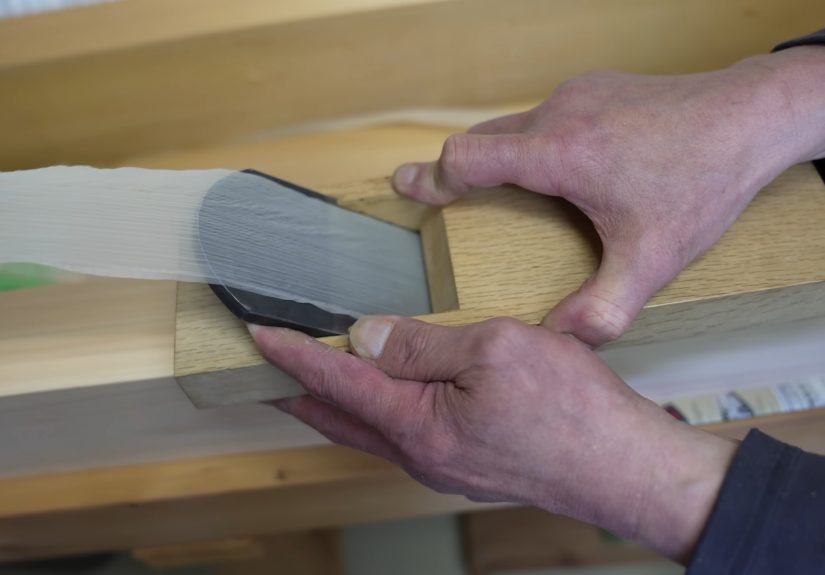
A Japanese hand plane, or kanna, is a traditional woodworking plane designed to cut on the pull stroke rather than the push stroke common in many Western planes. That one difference changes the feel of the tool immediately. Pulling can offer a sense of control and slicing action that many users find surprisingly intuitive once they get used to it. It also helps explain why the kanna has earned such a devoted following among craftspeople who care deeply about surface quality.
At first glance, the tool can look almost too simple: a block of wood, a blade, and sometimes a chipbreaker. No adjustment knob. No tote. No shiny lever cap. No mechanical drama. But simplicity here is not the same as crudeness. It is more like concentrated sophistication. The plane body is typically wooden, often white oak, while the blade is thick, tapered, and built to hold a wickedly sharp edge.
The Blade Is the Star of the Show
If the body of the plane is the stage, the blade is absolutely the lead actor. One reason Japanese hand planes have such mystique is their laminated blade construction. The cutting edge is formed from hard, high-carbon steel forge-welded to a softer iron or mild steel backing. That pairing matters. The hard steel gives the edge its cutting performance, while the softer backing helps with shock absorption and maintainability.
It is a wonderfully practical solution hiding inside a beautiful old-school process. Hard steel alone would be brittle and stubborn. Softer material alone would be easier to work with but would not keep that razor-like edge. Laminating the two gives the blade its reputation for sharpness and durability. It is one of those designs that makes you think, “Well, somebody solved that problem brilliantly a long time ago.”
Another detail woodworkers love is the ura, the hollow ground area on the blade’s flat side. That subtle hollow reduces the area that needs to be flattened during sharpening and helps make maintenance more efficient. In other words, even the blade’s geometry is quietly working overtime.
Inside the Factory: Why the Manufacturing Process Is So Fascinating
Watching a Japanese factory manufacture hand planes is like getting a front-row seat to the marriage of metallurgy and woodworking. The process often begins with forging work on the blade. Steel is joined to soft iron, heated, hammered, and shaped into a blank that will eventually become the plane iron. It is not flashy in a modern-tech way. It is flashy in a “humans figured out how to do amazing things with heat and force centuries ago” way.
Then comes the woodworking side of the equation. The kanna dai, or plane body, is prepared from hardwood and shaped with careful attention to angles, fit, and stability. Slots and pockets are cut so the blade can seat properly. This is where the intelligence of the design really comes into focus. A Japanese plane does not rely on screw-driven mechanisms to hold the blade in place. Instead, the blade’s taper and the geometry of the body create a friction fit.
That friction-fit system is one of the most elegant parts of the tool. It means the blade is retained without a dedicated wedge like many Western wooden planes and without the hardware-heavy adjustment systems found on modern metal-bodied models. The fit has to be right. Not “close enough.” Right. That requirement is part of what makes the manufacturing process look so calm and deliberate. You are not just making parts; you are creating relationships between parts.
And that is why the factory video is so oddly moving. You are watching workers build a tool that will not perform beautifully unless the tiniest details are respected. There is no room for laziness disguised as efficiency.
Why Kanna Users Talk About the Finish Like It’s a Religious Experience
Talk to people who love Japanese hand planes and one phrase comes up again and again: the surface. A well-tuned kanna can leave behind an incredibly refined finish, sometimes producing ultra-thin shavings and a polished-looking face on the wood itself. That is part performance, part setup, and part user skill. The plane is not magic. But it can look magical when everything clicks.
The pull stroke helps create a slicing action, and the blade geometry plays a role as well. Some woodworking references note that Japanese planes are often bedded at lower angles than typical Western bench planes, which can contribute to the way they slice softer woods cleanly. Add an extremely sharp edge, a carefully prepared sole, and a user who knows how to read the grain, and you get results that make people say things like, “I swear I can see the wood smiling.”
That may not be scientifically measurable, but spiritually? Very strong data.
Why a Japanese Plane Is Not Really an Out-of-the-Box Tool
One of the biggest misconceptions new admirers have is that a Japanese hand plane arrives ready for instant greatness. Not quite. A kanna is often better understood as a refined system that still expects the owner to participate. Many experienced users explain that these planes require setup, tuning, sharpening, and ongoing maintenance. In a sense, you do not simply buy the tool. You enter into a relationship with it.
That relationship includes fitting the blade properly, adjusting the projection with careful tapping, and maintaining the back and bevel through sharpening. It may also include uradashi, a maintenance method where the softer iron is tapped in a way that helps push the hard steel where needed as the blade wears over time. To someone new, this can sound slightly terrifying. Hammering a blade on purpose? Really? But in practice, it reflects how thoughtfully the tool is designed for a long working life.
In other words, the kanna is not trying to be low-commitment. It is not your “we should keep things casual” tool. It is more like the woodworking equivalent of learning a musical instrument: rewarding, humbling, and occasionally capable of making you question your life choices before suddenly producing something wonderful.
Japanese Hand Planes vs. Western Planes
Comparisons are inevitable, but they should be handled with a little grace. Western planes and Japanese planes are both excellent; they simply embody different traditions. Western metal planes often emphasize mechanical adjustability and immediate convenience. Japanese planes emphasize blade quality, body fit, and a more direct connection between user and tool.
A Western plane may feel more familiar to beginners because of its knobs, screws, and recognizable adjustment systems. A kanna can feel more mysterious at first because it asks for tuning and touch. But that mystery is part of the attraction. Once you understand the tool, the seeming simplicity starts to feel less like a barrier and more like clarity.
That also explains why watching a Japanese factory manufacturing hand planes is so satisfying even for people who do not own one. The process reveals a worldview. The tool is not designed around maximum convenience in the first five minutes. It is designed around performance, longevity, and mastery over years.
The Human Side of the Factory
Perhaps the most beautiful thing about the video is that it shows a factory without draining the soul out of the work. There are machines, yes, but the workers still matter. Their experience matters. Their eyes matter. Their hands matter. You can almost feel the accumulated know-how in each step: how long to heat, how firmly to strike, how cleanly to shape, how carefully to fit.
That matters because traditional craftsmanship is often romanticized as if it exists only in tiny one-person workshops. The reality is more nuanced. Skilled production can happen in small factories, cooperative shops, and specialized manufacturing spaces where expertise is distributed across different people and stages. That does not make the final tool less meaningful. If anything, it makes it more interesting. The plane becomes the result of shared craftsmanship rather than solitary mythology.
And that is probably one reason the video resonates so strongly. It respects labor. It respects process. It respects the fact that excellence is often repetitive, disciplined, and built one careful motion at a time.
What Modern Makers Can Learn from This Process
You do not need to become a Japanese woodworking purist to learn something from this manufacturing story. The lesson is broader than one tool. It is about design integrity. Every part of a kanna exists for a reason. The blade geometry, the body material, the pull stroke, the friction fit, the maintenance methodsthey all belong to one coherent system.
That kind of coherence is rare and refreshing. Too many products today are overcomplicated, overmarketed, and under-thought. By contrast, the Japanese hand plane reminds us that a tool can be minimal without being simplistic, traditional without being outdated, and beautiful without being merely decorative.
It also reminds us that quality takes time. A lot of time. Which may be annoying if you are in a hurry, but it is excellent news if you care about things that last.
Experiences Inspired by Watching Japanese Hand Planes Being Made
There is a particular feeling that comes from watching a beautiful Japanese factory manufacture hand planes, and it is hard to describe unless you have experienced it yourself. The first sensation is visual calm. Sparks jump, hammers fall, wood moves through cutters, and yet nothing feels rushed. The whole process has rhythm. It does not look lazy, and it certainly is not slow for the sake of looking artistic. It simply looks practiced. That distinction is important. Real skill rarely performs for the camera. It just does the work.
As a viewer, you start by admiring the craft, but then something else happens: you begin to rethink your relationship with ordinary objects. A hand plane stops being “just a tool” and becomes a record of decisions. Someone chose the steel. Someone judged the heat. Someone prepared the wood body. Someone understood the angle, the fit, the pressure, the finish. Suddenly the object feels less like merchandise and more like compressed human effort.
That experience can be unexpectedly emotional, even if you are not a woodworker. There is something reassuring about seeing competence so plainly on display. No hype. No gimmicks. No fake innovation dressed up in neon packaging. Just people making something carefully because careful work still matters. It can make the rest of modern life feel a little noisy by comparison.
For woodworkers, the reaction can be even stronger. Watching the process may trigger memories of the first time a sharp plane took a full shaving, the first time end grain looked clean instead of chewed up, or the first moment a hand tool felt like an extension of the body rather than an obstacle. A kanna represents that dream at an almost mythic level: the idea that, with enough attention, a tool can leave a surface so clean it feels finished straight from the cut.
There is also a humility built into the experience. The video gently reminds viewers that mastery is not a hack. It is not a shortcut, a secret setting, or a miracle accessory. It is repetition, correction, and accumulated judgment. Watching that can be inspiring in a very practical way. It encourages patience. It encourages better habits. It encourages a deeper appreciation for maintenance, tuning, and the so-called boring details that are usually the difference between mediocre results and excellent ones.
And then there is the simple pleasure of it all. Even if you never buy a Japanese hand plane, never flatten a blade, never attempt uradashi, and never learn the difference between a good shaving and a merely decent one, the experience still lands. It is satisfying because it shows a world where beauty and utility are not enemies. A tool can be functional and elegant. A factory can be efficient and humane. A process can be old-fashioned and still feel timeless. That is a rare kind of viewing experienceand a pretty wonderful one.
Final Thoughts
Watch This Beautiful Japanese Factory Manufacturing Hand Planes is more than a catchy title. It is an invitation to slow down and look closely at one of woodworking’s most respected tools. The video captures why the kanna continues to fascinate makers around the world: the laminated blade, the disciplined fit, the pull-stroke action, the extraordinary finish, and the sense that every small detail matters.
More than that, it offers a refreshing picture of manufacturing itself. Not soulless output. Not nostalgia for nostalgia’s sake. Just skilled people producing something durable, clever, and beautiful. In a time when many things are built to be replaced, a Japanese hand plane still feels built to be understood.
And that may be the most beautiful part of all.