Table of Contents >> Show >> Hide
- What Is a Lunar Eclipse, Exactly?
- How Does a Lunar Eclipse Happen?
- Why Does a Lunar Eclipse Only Happen During a Full Moon?
- The Three Main Types of Lunar Eclipses
- Why Does the Moon Turn Red During a Lunar Eclipse?
- How Long Does a Lunar Eclipse Last?
- Can You See a Lunar Eclipse From Anywhere?
- Is It Safe to Look at a Lunar Eclipse?
- What Is the Difference Between a Lunar Eclipse and a Solar Eclipse?
- Why Lunar Eclipses Matter Beyond the Pretty Photos
- Common Myths About Lunar Eclipses
- How to Watch a Lunar Eclipse Like a Pro
- What Does a Lunar Eclipse Feel Like? Real Experiences Under the Shadowed Moon
- Conclusion
A lunar eclipse is one of those rare sky events that can make even the most committed indoor person step outside, look up, and whisper, “Okay, wow.” It happens when Earth moves directly between the Sun and the Moon, causing Earth’s shadow to fall across the Moon. In plain English: our planet briefly photobombs the full moon.
But a lunar eclipse is more than a pretty cosmic trick. It is a beautiful lesson in astronomy, motion, light, shadow, and timing. It can turn a bright full moon rusty red, darken only part of the lunar surface, or create such a subtle dimming that people squint and ask, “Is it happening, or am I just tired?” If you have ever wondered what a lunar eclipse really is, why it happens, why the Moon sometimes looks red, and whether you need special glasses to watch it, you are in exactly the right place.
Let’s break it down without making it feel like a pop quiz from science class.
What Is a Lunar Eclipse, Exactly?
A lunar eclipse happens when the Moon passes into Earth’s shadow during a full moon. Normally, the full Moon glows because sunlight reflects off its surface and travels back to Earth. During an eclipse, Earth blocks some or all of that sunlight from reaching the Moon.
The key detail is alignment. For a lunar eclipse to happen, the Sun, Earth, and Moon must line up in almost a straight line, with Earth in the middle. When that alignment is just right, Earth casts a shadow on the Moon, and skywatchers on the nighttime side of Earth get a front-row seat.
So, if you want the simplest possible definition, here it is: a lunar eclipse is the darkening of the Moon caused by Earth’s shadow.
How Does a Lunar Eclipse Happen?
Picture the Sun shining on Earth. Just like any object under bright light, Earth throws a shadow behind it. That shadow stretches into space, and if the Moon travels through it while orbiting Earth, you get a lunar eclipse.
There are two parts of Earth’s shadow, and both matter:
The Penumbra
This is the lighter, outer part of Earth’s shadow. When the Moon moves through the penumbra, the dimming can be so gentle that many people barely notice it at first. It is the “something looks a little off” phase.
The Umbra
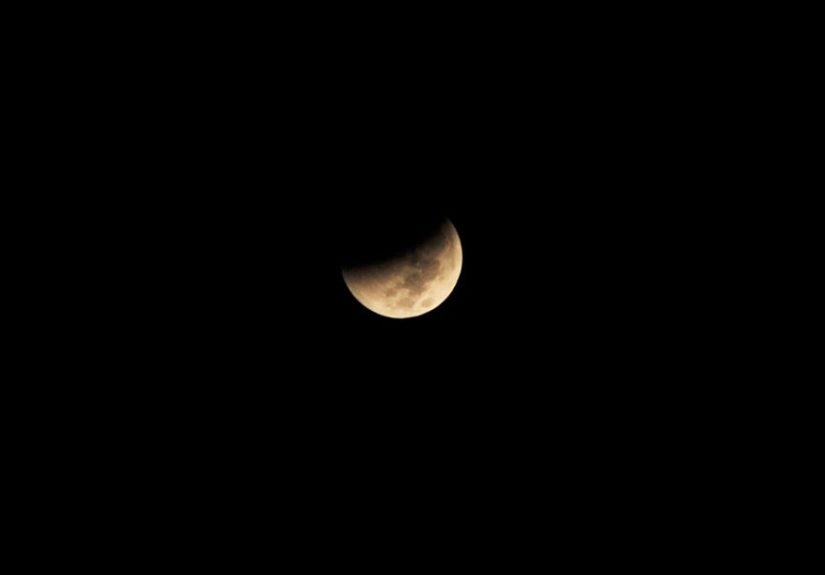
This is the dark, central part of the shadow. When the Moon enters the umbra, the eclipse gets dramatic. A bite-like dark curve may appear on one edge of the Moon. If the entire Moon moves into the umbra, you get a total lunar eclipse.
That curved shadow is not random, by the way. Ancient observers noticed it and used it as evidence that Earth is round. Not bad for an event that also gives modern people an excuse to stay up too late with a blanket and a thermos.
Why Does a Lunar Eclipse Only Happen During a Full Moon?
A lunar eclipse can only happen during a full moon because that is the phase when the Moon is on the opposite side of Earth from the Sun. If the Moon is not full, the geometry is wrong, and Earth’s shadow will not fall across the lunar surface in the right way.
Still, not every full moon brings an eclipse. If it did, lunar eclipses would be a monthly event and far fewer people would dramatically post them on social media.
The reason is that the Moon’s orbit is tilted slightly compared with Earth’s orbit around the Sun. Most months, the Moon passes a little above or a little below Earth’s shadow. Only when the Moon crosses the orbital plane at the right moment during a full moon do we get an eclipse.
The Three Main Types of Lunar Eclipses
Not all lunar eclipses look the same. Some are subtle. Some are spectacular. Some make people drag lawn chairs into the driveway. Astronomers usually divide lunar eclipses into three main types.
1. Penumbral Lunar Eclipse
In a penumbral lunar eclipse, the Moon passes only through Earth’s penumbra. This causes a faint shading across the lunar surface. It is the shyest eclipse type. If you are not paying attention, you might miss it entirely and assume the Moon is just having an off night.
2. Partial Lunar Eclipse
In a partial lunar eclipse, part of the Moon enters Earth’s umbra while the rest remains in sunlight or the penumbra. This creates a striking dark section that seems to creep across the Moon. It often looks like someone took a neat, celestial bite out of it.
3. Total Lunar Eclipse
In a total lunar eclipse, the entire Moon moves into Earth’s umbra. This is the headline act. Instead of vanishing completely, the Moon usually turns a deep red, orange, or copper color. That is why total lunar eclipses are often nicknamed blood moons.
Total lunar eclipses are the most dramatic and memorable type, especially because the Moon changes appearance slowly enough for people to really watch the transformation happen.
Why Does the Moon Turn Red During a Lunar Eclipse?
This is the part that makes people feel like the universe hired a lighting designer.
During a total lunar eclipse, the Moon often looks red because some sunlight still reaches it, but not directly. That light passes through Earth’s atmosphere first. As it does, shorter blue wavelengths scatter more easily, while red and orange wavelengths continue through and bend toward the Moon.
In other words, Earth’s atmosphere filters and redirects sunlight. The same basic physics that makes sunsets look red also gives an eclipsed Moon its eerie glow. When you look at a blood moon, you are essentially seeing the combined color of sunrises and sunsets around Earth projected onto the lunar surface. Which is honestly a pretty poetic thing for science to pull off.
The exact shade can vary. Dust, clouds, pollution, volcanic particles, and other atmospheric conditions can make the Moon appear brighter red, darker brown, or more orange than usual.
How Long Does a Lunar Eclipse Last?
One reason lunar eclipses are so enjoyable is that they do not rush. Unlike a total solar eclipse, which can feel heartbreakingly brief, a lunar eclipse unfolds slowly.
The entire event, from the first subtle penumbral shading to the Moon fully leaving Earth’s shadow, can take several hours. The most dramatic part, called totality, often lasts from around 30 minutes to over an hour, depending on the specific alignment.
That means you usually have plenty of time to step outside, adjust your eyes, take photos, text a friend “LOOK AT THE MOON RIGHT NOW,” and still catch the best part.
Can You See a Lunar Eclipse From Anywhere?
Not everywhere at once, but a lunar eclipse is visible from a much larger part of Earth than a solar eclipse. If the Moon is above the horizon where you are and the sky is clear, you can usually watch it.
That is because the eclipsed Moon is visible to everyone on the nighttime side of Earth. You do not need to be in a narrow path of totality as you do with a solar eclipse. This wide visibility is one reason lunar eclipses tend to feel like shared global events.
Your local experience depends on timing. In one place, the Moon may already be high in the sky when the eclipse begins. In another, it may rise already partially eclipsed. In some locations, it may set before the event is over. Astronomy loves to be dramatic, but it also loves schedules.
Is It Safe to Look at a Lunar Eclipse?
Yes. A lunar eclipse is safe to view with the naked eye. You do not need eclipse glasses, special filters, or any elaborate safety setup.
That is one of the biggest differences between a lunar eclipse and a solar eclipse. Looking directly at the Sun during a solar eclipse can damage your eyes. Looking at the Moon during a lunar eclipse is perfectly safe. Go ahead and stare respectfully.
Binoculars or a small telescope can make the experience even better by revealing more detail on the Moon’s surface and the subtle color changes during totality, but they are optional. Your eyes are enough.
What Is the Difference Between a Lunar Eclipse and a Solar Eclipse?
People mix these up all the time, which is understandable because both involve the Sun, Earth, and Moon lining up. The difference is all about who stands in the middle.
- Lunar eclipse: Earth moves between the Sun and the Moon, so Earth’s shadow falls on the Moon.
- Solar eclipse: The Moon moves between the Sun and Earth, so the Moon’s shadow falls on Earth.
A solar eclipse happens during a new moon. A lunar eclipse happens during a full moon. Solar eclipses require eye protection. Lunar eclipses do not. Solar eclipses are visible from a relatively narrow path. Lunar eclipses can be seen from much of the nighttime half of Earth.
Both are amazing. One just asks a lot less from your eyeballs.
Why Lunar Eclipses Matter Beyond the Pretty Photos
Yes, lunar eclipses are gorgeous. Yes, they make excellent social media content. But they also matter scientifically and historically.
For centuries, eclipses helped humans understand celestial motion, the shape of Earth, and the predictability of the sky. They connected observation with mathematics in a way that shaped astronomy itself. Even today, eclipses are powerful teaching tools because they turn abstract orbital mechanics into something visible and unforgettable.
They also carry cultural meaning. Different societies have interpreted eclipses in different ways: as omens, warnings, myths, signs of conflict, or moments for reflection. Modern science explains the mechanics, but the emotional effect remains. A darkened red moon still has a way of making people pause mid-sentence.
Common Myths About Lunar Eclipses
Myth 1: A Lunar Eclipse Is Dangerous to Watch
False. Lunar eclipses are safe to view without eye protection.
Myth 2: The Moon Turns Red Because It Is Getting Hotter
Nope. The red color comes from sunlight filtered through Earth’s atmosphere, not because the Moon is suddenly roasting like a marshmallow.
Myth 3: Every Full Moon Can Produce a Lunar Eclipse
Not true. The Moon’s tilted orbit means the alignment usually misses Earth’s shadow.
Myth 4: A Blood Moon Means Something Supernatural Is Happening
It may feel dramatic, but the event is a natural and predictable result of orbital motion and atmospheric scattering.
How to Watch a Lunar Eclipse Like a Pro
You do not need to own a telescope the size of a water heater. A few simple steps can improve the experience.
- Check the timing: Find local eclipse times in advance so you know when the interesting phases happen.
- Pick a good spot: Choose a place with a clear view of the sky and as few bright lights as possible.
- Watch early: The penumbral phase can be subtle, but starting early helps you notice the Moon’s gradual change.
- Bring binoculars: They are optional, but great for seeing texture and color changes.
- Dress for the weather: Nothing ruins cosmic wonder like being cold and pretending you are fine.
- Be patient: Lunar eclipses are slow-motion sky theater. Let the event build.
What Does a Lunar Eclipse Feel Like? Real Experiences Under the Shadowed Moon
The science of a lunar eclipse explains what is happening. The experience of a lunar eclipse explains why people remember it for years.
If you have never seen one in person, the first surprise is how gradual it is. Nothing explodes into action. There is no dramatic soundtrack, unless you bring your own and decide Hans Zimmer is necessary for backyard astronomy. At first, the Moon simply looks a little dimmer, a little different, like someone adjusted the brightness by five percent. Then the shadow becomes obvious. The edge of darkness is curved and clean, and suddenly the whole event feels physical, as though you are watching the geometry of the solar system happening live above your roof.
Many people describe the experience as calming rather than shocking. A solar eclipse can feel intense and eerie because daylight changes. A lunar eclipse feels quieter. The night remains night. The stars seem a little more noticeable. Conversations get softer. People stop checking their phones every six seconds. It is one of those rare moments when a group of humans willingly looks at the same thing without arguing.
Families often turn lunar eclipses into memory-making events. Parents wrap kids in blankets, bring out hot chocolate, and point at the Moon while trying to sound casual and educational at the same time. Amateur photographers line up tripods and whisper angrily at camera settings. Neighbors who have never spoken beyond “hello” suddenly become eclipse buddies. Someone always says, “It looks way cooler in person,” and for once that sentence is absolutely correct.
There is also something strangely emotional about the red phase of totality. The Moon does not disappear. It lingers, glowing dimly in copper and rust, looking both familiar and completely transformed. It can feel ancient, theatrical, and slightly unreal. Even people who know the physics by heart often admit that a total lunar eclipse still feels a little magical.
For skywatchers, the best part is often the pace. You have time to notice details: the slow spread of shadow, the changing brightness of the lunar maria, the way the red color deepens near the middle of totality, and the way the Moon gradually brightens again as it leaves Earth’s umbra. It is not a blink-and-you-miss-it event. It is a stay-awake-and-soak-it-in event.
And that may be why lunar eclipses leave such a strong impression. They make astronomy feel personal. You are not just reading about orbital alignment in a diagram. You are standing on a spinning planet, watching its shadow fall across another world. That is a wild sentence to say out loud, and an even wilder thing to witness.
So yes, a lunar eclipse is a science event. But it is also a human event: a pause button, a shared experience, a reminder that the sky still knows how to surprise us.
Conclusion
So, what is a lunar eclipse? It is the moment Earth moves between the Sun and the Moon, casting its shadow across the full Moon and transforming a familiar night-sky object into something unforgettable. Depending on the alignment, the eclipse may be penumbral, partial, or total. In the most dramatic cases, the Moon glows red because sunlight bends through Earth’s atmosphere before reaching the lunar surface.
Lunar eclipses are easy to appreciate because they are safe to watch, visible across large areas, and slow enough to enjoy without panic-snacking through the important part. They are also a perfect example of how science and wonder can share the same sky. Once you understand the mechanics, the event becomes even more impressive, not less.
The next time a lunar eclipse rolls around, step outside. Bring a chair, maybe a sweater, and definitely a little curiosity. Earth’s shadow has a show to put on.