Table of Contents >> Show >> Hide
- First, a reality check: should you even make hand sanitizer?
- Know what sanitizer can (and can’t) do
- The one number that decides whether your sanitizer works: alcohol percentage
- Ingredients: what helps, what hurts, what’s a marketing fairy tale
- Safety isn’t optional: alcohol-based sanitizer is flammable
- Kid (and pet) safety: the bottle is not a snack
- Skin health: don’t turn your hands into desert jerky
- Containers and labeling: boring, but it prevents disasters
- The legal and ethical part: personal use is different from selling
- If you still want to make sanitizer for personal use: a safer checklist
- Common mistakes (so you can avoid them without learning the hard way)
- Conclusion: make it smart, or don’t make it
- Experiences & lessons people learn after making sanitizer (so you can learn them now)
- The “wow, this is runnier than expected” moment
- The scent surprise (aka “Why does this smell like a hospital gift shop?”)
- The evaporation lesson: caps matter more than confidence
- The “kids will find it” rule
- Skin care becomes part of the “sanitizer system”
- The biggest takeaway: “DIY is only worth it if you measure”
Making hand sanitizer sounds like one of those “adulting” flexes: you’ve got a mixing bowl, a heroic playlist,
and the confidence of someone who once assembled IKEA furniture without leftover screws. But sanitizer
isn’t banana bread. If you get the proportions wrong, you don’t end up with a weird loaf you end up with a
bottle of expensive-smelling nothing (or, in worst cases, something unsafe).
This guide walks you through the real-world stuff to know before you start making sanitizer:
what works, what doesn’t, what’s risky, and how to avoid the classic DIY mistakes that turn “prepared” into
“why does this smell like regret?”
First, a reality check: should you even make hand sanitizer?
If you can buy a reputable, properly labeled hand sanitizer, that’s usually the safer move. Commercial products
are formulated and tested to hit effective alcohol levels, feel decent on skin, and stay stable over time.
Homemade mixes can fall below the minimum effective alcohol concentration, get contaminated, separate, evaporate,
or irritate skin sometimes all in one dramatic bottle.
Homemade sanitizer makes the most sense in narrow scenarios: short-term shortages, travel kits you control,
or special situations where you can measure accurately and label clearly. If your plan is “I’ll eyeball it,”
your plan is also “I’ll accidentally make fancy-smelling water.”
Know what sanitizer can (and can’t) do
Sanitizer is not soap, and it doesn’t “clean”
Alcohol-based hand sanitizer can kill many germs, but it doesn’t remove dirt, grease, pesticides,
or chemicals. If your hands are visibly dirty think gardening soil, cooking oil, sunscreen buildup, car-repair
grime soap and water usually win. Soap lifts gunk off your skin so it can rinse away. Sanitizer mostly works
by inactivating microbes on the skin you rub it over.
Sanitizer is for hands not countertops, not lettuce, not your dog
A very common mistake is using hand sanitizer as a “universal disinfectant.” Hand sanitizer is formulated for skin.
Hard-surface disinfectants are regulated differently, often require specific contact times, and may include other
ingredients not meant for bodies. If you need to disinfect surfaces, use a product intended and labeled for that purpose.
(And no, please don’t sanitize your salad.)
Technique matters more than people think
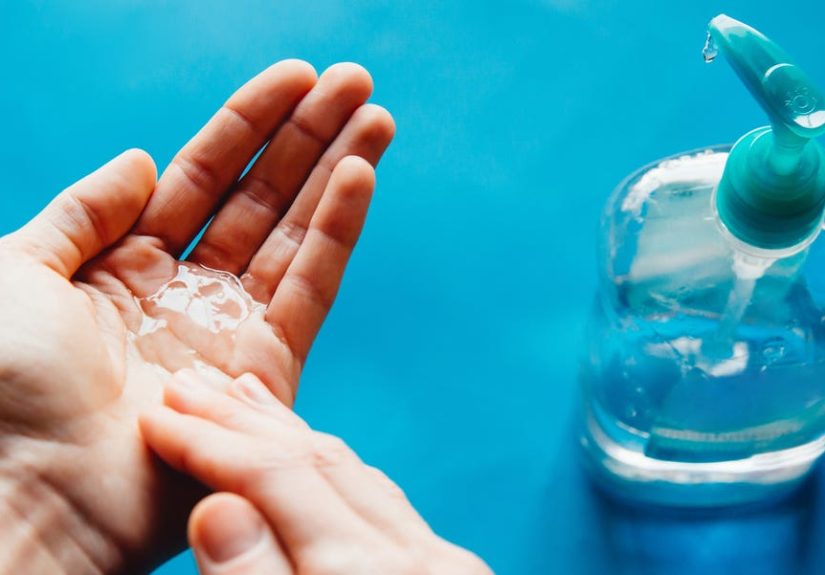
Even perfect sanitizer fails if used like a quick dab. You need enough product to wet your hands and you need to rub
all hand surfaces palms, backs, between fingers, around nails until fully dry. If it dries in five seconds,
you likely didn’t use enough. If you wave your hands around like you’re landing a plane, you’re doing cardio, not hygiene.
The one number that decides whether your sanitizer works: alcohol percentage
For hand sanitizer to be effective, the alcohol concentration needs to be high enough. In practical terms, the widely used
benchmark is at least 60% alcohol (and many effective products sit in the 60%–95% range).
Below that, performance drops fast.
Ethanol vs. isopropyl alcohol: both can work
Most alcohol-based hand sanitizers use either ethanol (ethyl alcohol) or isopropyl alcohol.
Both can be effective when formulated at the right concentration. What matters most for DIY is that the bottle you start with
clearly states the alcohol percentage and that your final mix stays above the effective threshold.
Do not confuse “proof” with “percent”
If you’re thinking, “I have vodka,” let’s do the math you won’t like. Most vodka is 80 proof, which equals 40% alcohol.
That’s below the typical minimum for effective hand sanitizer. Mixing it with gel only lowers it further. Your DIY sanitizer will be
a nice-smelling placebo which is not the vibe.
DIY alcohol math: two examples people get wrong
You don’t need a chemistry degree. You need a calculator and humility.
- Example A: Using 99% isopropyl alcohol
Let’s say you mix 2 parts of 99% alcohol with 1 part aloe gel.
Your final alcohol concentration is about: (2 × 99) / 3 ≈ 66%. That clears the typical minimum. - Example B: Using 70% isopropyl alcohol
Same “2 parts alcohol, 1 part gel” with 70% alcohol gives: (2 × 70) / 3 ≈ 46%.
That’s not high enough. This is the classic DIY trap: the recipe looks identical, the outcome isn’t.
If you remember only one thing: your starting alcohol concentration determines whether DIY is even possible.
If you start too low, there’s no magical stirring technique that saves it.
Ingredients: what helps, what hurts, what’s a marketing fairy tale
What you actually need
- High-strength alcohol (ethanol or isopropyl alcohol with a clearly labeled percentage).
- A humectant (something that helps reduce dryness), commonly glycerin or aloe gel.
This is optional for effectiveness, but helpful for comfort. - Clean containers that can close tightly to slow evaporation.
- A way to measure accurately (measuring cup with clear markings, preferably a scale for precision).
What to avoid (seriously)
- Methanol or “wood alcohol.” It’s toxic and not acceptable for hand sanitizer.
If your alcohol source is suspicious, unlabeled, imported from a sketchy listing, or smells “off,” don’t use it. - Random industrial solvents or unlabeled “bulk alcohol.” If you can’t verify what it is, assume it’s not safe.
- Too many essential oils/fragrances. They don’t make sanitizer more effective, and they can irritate skin or trigger allergies.
- Food coloring, glitter, or “fun” additives. Congratulations, you made craft gel. Germs are unimpressed.
What about hydrogen peroxide?
Some well-known formulations include a small amount of hydrogen peroxide. In those recipes, it’s not there to “sanitize your hands harder.”
It’s generally used to help reduce contamination in the mixture itself (for example, reducing spores in the solution over time).
It is not a substitute for the alcohol component and it’s not the main active ingredient for hand rub performance.
Safety isn’t optional: alcohol-based sanitizer is flammable
If your sanitizer is effective, it’s probably also flammable because effective sanitizer is mostly alcohol.
Treat it like you’d treat a flammable household chemical: keep it away from open flames, hot surfaces, smoking areas,
and heat sources. Don’t store large quantities next to your water heater like you’re auditioning for a fire safety video.
Ventilation and mixing space
Mixing alcohol in a tiny, closed bathroom is not ideal. Alcohol vapors can build up, and the smell alone can make you feel like
you’re living inside a permanent “cleaning day” montage. Use a well-ventilated space, keep containers closed when not pouring,
and wipe spills promptly.
Evaporation: the sneaky thief of effectiveness
Alcohol evaporates quickly. Leave your mixture open too long or use a leaky bottle and your carefully calculated percentage
can drift downward. Tight caps, sturdy bottles, and not “forgetting it uncapped on the counter” matter more than your aesthetic label font.
Kid (and pet) safety: the bottle is not a snack
Many hand sanitizers smell sweet, fruity, or like candy which is a terrible design choice if you share a home with toddlers,
who are basically tiny chaos scientists. Swallowing hand sanitizer can cause alcohol poisoning, especially in children.
Keep sanitizer out of reach, supervise young kids, and don’t let them wander around with a mini bottle like it’s a sippy cup accessory.
Extra caution for households with teens: there have been reports of intentional ingestion or misuse. If you’re making sanitizer at home,
label it clearly and store it like you would any alcohol-containing product.
Skin health: don’t turn your hands into desert jerky
Frequent sanitizer use can dry and irritate skin. That’s not just annoying cracked skin can make hand hygiene harder and more uncomfortable.
A few practical tips:
- Let sanitizer dry completely before applying moisturizer. Layering lotion onto wet sanitizer can dilute it and feels gross.
- Choose fragrance-free when possible, especially if you have sensitive skin or eczema.
- If your hands are visibly dirty, wash with soap and water instead of repeatedly sanitizing you’ll often get better results
with less irritation.
Containers and labeling: boring, but it prevents disasters
Pick the right container
Use clean, sealable bottles. Avoid containers that previously held food or drinks if there’s any chance someone could confuse them.
(No one should ever take a heroic gulp from a “water bottle” and discover it’s actually 70% isopropyl. That’s a plot twist nobody deserves.)
Label like a responsible human
At minimum, label:
- “Hand Sanitizer External Use Only”
- Alcohol type and approximate percentage (based on your calculation)
- Ingredients
- Date made
- Keep away from heat/flame
The legal and ethical part: personal use is different from selling
In the United States, hand sanitizer is generally regulated as an over-the-counter drug product when marketed for preventing disease.
That means there are rules about manufacturing, labeling, and quality controls. If you make sanitizer at home,
keep it for personal use. Selling, distributing, or donating homemade sanitizer (especially unlabeled) can create legal
and safety problems you don’t want.
Also: don’t make medical claims. “Kills 99.99% of everything including your bad decisions” is funny on a sticker, but not a claim you can back up,
and it’s not how responsible hygiene products are communicated.
If you still want to make sanitizer for personal use: a safer checklist
This is not medical or regulatory advice it’s a practical “don’t mess this up” checklist.
If you can’t do these steps, consider buying a commercial product instead.
Pre-mix checklist
- Verify alcohol percentage on the bottle (don’t guess).
- Decide your target: keep the final product at or above the typical minimum (commonly 60%+).
- Measure using marked tools (or a scale). Eyeballing is for pancakes, not sanitizer.
- Choose a clean, sealable bottle that won’t leak or evaporate quickly.
- Keep additives minimal so you don’t dilute alcohol too far or irritate skin.
A practical “do the math” formula
Use this simple concept: Final % ≈ (Alcohol % × Alcohol volume) ÷ Total volume.
If you add gel or glycerin, that’s part of total volume and it lowers the final percentage.
If you want gel texture, add just enough thickener/humectant to make it usable not so much that you quietly dilute your sanitizer into
a fancy hand smoothie.
Common mistakes (so you can avoid them without learning the hard way)
1) Starting with 70% alcohol and adding a lot of gel
This is the #1 DIY fail. The final mixture drops below effective levels and gives you false confidence. If your starting alcohol is 70%,
you have very little “dilution room.”
2) Using beverage alcohol
Most beverage alcohol is too low in concentration. High-proof spirits exist, but the moment you start “DIY mixing” without lab precision,
you risk missing the effective threshold. Save the spirits for their intended purpose: awkward holiday gatherings.
3) Over-fragrancing
Essential oils won’t make sanitizer “stronger.” They can make it irritating. If you must add fragrance, use a tiny amount and keep safety first.
4) Assuming more alcohol is always better
Extremely high concentrations (approaching pure alcohol) can evaporate quickly and may not perform as well as properly balanced formulations.
The goal is an effective range with enough contact time on skin.
Conclusion: make it smart, or don’t make it
Before making sanitizer, get crystal clear on what you’re trying to achieve: an alcohol-based hand rub that stays at an effective concentration,
is safe to store, and is tolerable on skin. That means accurate measurement, minimal dilution, careful storage, and realistic expectations.
Soap and water remain your gold standard when available. When they aren’t, a correctly formulated sanitizer can be a useful backup
but only if it’s actually strong enough to do the job.
Experiences & lessons people learn after making sanitizer (so you can learn them now)
People who try DIY hand sanitizer tend to discover the same truths in the same order kind of like how everyone learns that “just one more episode”
is a lie we tell ourselves. Here are some experience-based lessons commonly reported by home mixers, small teams, and families who tried to
make sanitizer during shortages or for travel kits.
The “wow, this is runnier than expected” moment
Many people assume sanitizer must be a thick gel. Then they mix alcohol with a little aloe and realize they’ve invented something closer to
“moist hand cologne.” The temptation is to add more gel until it feels right and that’s exactly how alcohol levels quietly drop below effective
thresholds. The practical takeaway: texture is secondary. If you need thickness, increase it carefully, and re-check your final concentration
math instead of chasing the perfect wobble like it’s a dessert competition.
The scent surprise (aka “Why does this smell like a hospital gift shop?”)
Even when ingredients are safe, the smell can be… assertive. Rubbing alcohol smells like rubbing alcohol because it is rubbing alcohol.
Some people add essential oils to make it “nice,” then regret it when their hands sting or their skin reacts. Others discover that fragrance
plus alcohol can smell like a strange cocktail: “notes of lavender” with a “finish of chemical factory.”
A common compromise is to skip fragrance entirely and use a good hand cream afterward. Your hands get comfort, and your nose stops filing complaints.
The evaporation lesson: caps matter more than confidence
A recurring DIY story goes like this: someone makes a batch, leaves the cap loosely on a bottle, and a week later it’s thicker, smells different,
and feels weaker. Alcohol evaporates. If the cap leaks, the formula changes. People often learn to store sanitizer in sturdy, tightly sealed
containers (travel bottles that actually seal, not the ones that “mostly seal” unless Mercury is in retrograde).
A small habit closing the cap promptly makes a big difference in keeping the product consistent.
The “kids will find it” rule
If there’s a colorful bottle with a fruity scent, kids will discover it with the focus of a detective and the speed of a squirrel.
Families commonly report that the safest routine is: adults dispense it, kids rub it, and the bottle goes right back up high.
People also learn fast not to reuse food or drink containers for sanitizer because at some point someone will try to sip first and ask questions later.
Clear labeling and boring packaging can be a safety feature, not a branding failure.
Skin care becomes part of the “sanitizer system”
Heavy sanitizer use often leads to dry, tight hands especially in winter or in workplaces where hand hygiene is constant.
People who stick with sanitizer long-term usually add a routine: sanitize, let dry, moisturize. Over time, many switch to fragrance-free options,
keep a small tube of hand cream nearby, and prioritize soap-and-water washes when hands are dirty. The big lesson is that
hygiene works better when your skin barrier isn’t cracked and miserable. Comfort supports consistency.
The biggest takeaway: “DIY is only worth it if you measure”
The most consistent experience people share is this: DIY sanitizer is not forgiving. If you can measure accurately and do the math, you can make a
personal-use product that’s likely to be effective. If you can’t, you’re better off buying a reputable sanitizer and spending your DIY energy on
something lower-stakes like making cookies, where “a little extra vanilla” is a delight and not a public health issue.
If you take anything from these experiences, let it be this: sanitizer isn’t about vibes. It’s about concentration, technique, and safety.
Do it carefully, or skip it proudly.