Table of Contents >> Show >> Hide
- The short answer (with a simple timeline)
- What do newborns actually see at birth?
- Newborn vision development month by month (what to expect)
- How vision develops: what’s changing behind the scenes?
- How far can newborns see?
- How to support healthy baby eyesight (simple, realistic tips)
- Vision screening and eye exams: when to check in
- Red flags: when to call your pediatrician sooner
- FAQs about newborn vision
- Real-life experiences: what parents commonly notice (and what it can mean)
- 1) “My newborn stares at me like I’m a fascinating lamp.”
- 2) “The ceiling fan is their best friend. Should I be jealous?”
- 3) “They don’t seem interested in toys, but they love faces.”
- 4) “Photos show a weird white shine in one eye.”
- 5) “One eye always looks like it’s drifting. Everyone says they’ll grow out of it.”
- 6) “Around 4–6 months, my baby suddenly started grabbing everythingaccurately.”
- Conclusion
If you’ve ever held a brand-new baby and wondered, “Are you looking at me… or through me… or at the ceiling fan like it’s paying rent?”you’re in excellent company.
Newborn vision is real, it’s working, and it’s also a little like opening a camera app with a smudged lens, low battery, and the autofocus still booting up.
The good news: baby eyesight improves fast during the first year, and there are clear infant vision milestones you can watch for without turning your living room into an optometry lab.
The short answer (with a simple timeline)
Newborns can see from birth, but their vision starts out blurry and best up close. Think “close-range face appreciation,” not “reading the fine print on a onesie tag.”
Over the first weeks and months, babies gain better focus, smoother tracking, clearer detail, richer color vision, and (eventually) depth perception.
- Birth to 2 weeks: Sees light/dark and large shapes; best focus is close; high-contrast patterns stand out.
- 1 month: Stares at faces; may briefly follow objects; eyes may look uncoordinated at times.
- 2 to 3 months: Better eye teaming; starts tracking moving objects and faces more smoothly.
- 4 to 5 months: Stronger focus; improved color vision; reaches for what they see.
- 6 months: More consistent tracking; depth perception begins to strengthen; lots of “grabby hands” meet “target acquired.”
- 9 to 12 months: Watches fast-moving things; spots smaller objects; uses vision to guide crawling/cruising and play.
What do newborns actually see at birth?
Newborn eyesight is often described as blurry with a strong preference for close, high-contrast targets. Many pediatric resources estimate
newborn visual clarity around the 20/200–20/400 range (there’s natural variation), which means detail that adults see clearly far away needs to be much closer
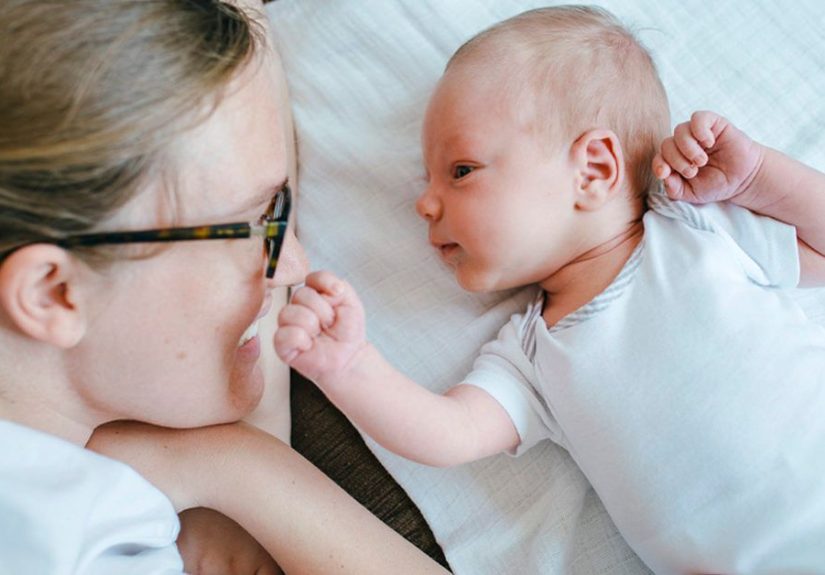
for a baby to see it well. That’s why your face is most interesting when it’s near theirsand why “face time” during feeding is basically a built-in vision activity.
The “sweet spot” distance: about 8–12 inches
One of the most consistent baby vision facts you’ll see across pediatric and eye-health guidance: newborns focus best at roughly 8 to 12 inches awayabout the
distance from your arms to your face when you’re holding or feeding your baby. In other words, newborn vision is designed for bonding, not birdwatching.
High contrast beats pastel perfection
Newborns tend to prefer bold patternsthink black-and-white shapes and sharp contrast. Subtle pastel nursery art is lovely (and you should absolutely enjoy it),
but your newborn may be more impressed by the dramatic visual thrill ride of… a striped blanket.
Newborn vision development month by month (what to expect)
Birth to 1 month: “I see something… maybe”
In the earliest weeks, babies can detect light, shapes, and movement, and they’ll often stare at faces when held close. You may notice the eyes wandering or appearing crossed
at timeseye muscles and coordination are still developing. This can look odd, but it’s commonly part of early visual development.
Pro tip: keep interactions close and simple. Your baby doesn’t need a visual buffet. They need a few clear “stars of the show”: your face, a bold pattern, a simple toy.
2 to 3 months: tracking begins to look smoother
Around this stage, you’ll often see improved focus and better tracking of moving objectsespecially faces. Babies start to follow things with their eyes more reliably,
and eye teaming (both eyes working together) generally improves.
A fun, low-effort activity: slowly move a high-contrast toy side to side about 8–12 inches from your baby’s face, and watch for smoother tracking. Keep it gentle
this is “baby yoga,” not an action movie chase scene.
4 to 5 months: color and coordination level up
Color vision becomes richer over time, and many babies show noticeably better color discrimination by the middle of the first year. You may also notice more accurate reaching:
your baby’s hands start trying to grab what their eyes are excited about (which is adorable… and occasionally your hair).
6 to 8 months: depth perception joins the party
Depth perceptionjudging what’s near vs. fardevelops later than basic “I see a thing” vision. As babies start moving more (rolling, sitting, crawling),
their brains get more practice linking vision with body movement. This is one reason babies can suddenly become very interested in edges, steps, and “How dare gravity exist?”
moments. (Cue your baby-proofing era.)
9 to 12 months: sharper detail and faster visual reactions
By late infancy, babies can spot smaller objects, track faster movement, and use vision more effectively for playlike searching for a dropped toy or enjoying peek-a-boo.
Their baby eyesight is still developing, but it’s far more functional than in the newborn days.
How vision develops: what’s changing behind the scenes?
Infant vision development isn’t just “the eyes getting stronger.” It’s a whole system learning to work together: the retina capturing images, the brain interpreting them,
and the eye muscles coordinating focus, tracking, and alignment.
1) Focus (accommodation)
Newborns have a harder time changing focus between distances. Early on, close-range viewing is easiest. Over the first months, babies get better at focusing on objects
farther away and shifting attention between targets.
2) Eye alignment and teamwork
In the first couple of months, it’s common for babies’ eyes to look like they aren’t perfectly coordinated all the time. But persistent or constant misalignment,
especially beyond the early months, is something to flag for a pediatrician.
Pediatric guidance commonly treats constant eye turning as a concern at any age, and eye misalignment that continues beyond early infancy may warrant evaluation.
3) Color vision
Color perception develops gradually. Many sources describe early preference for high-contrast visuals, with color discrimination becoming more sensitive over the first months.
By around the middle of the first year, many babies demonstrate much stronger color vision compared with the newborn period.
4) Depth perception
Depth perception relies on both eyes working together plus brain processing of visual cues. It’s not fully present at birth and improves as babies gain motor skills
and visual experience.
How far can newborns see?
In the newborn stage, distance vision is limited. The “best focus” range is closeagain, the famous 8–12 inches. Over the next months, the range expands.
By a few months old, many babies can notice you from farther away (and may reward you with a smile that makes you forget what sleep felt like).
How to support healthy baby eyesight (simple, realistic tips)
You don’t need flashcards, apps, or a tiny pair of reading glasses. Supporting newborn eyesight development is mostly about giving babies the right kind of visual practice
and keeping them safe.
Use faces and close interaction
Your face is prime newborn entertainment. Talk, sing, smile, and hold your baby close enough for that 8–12 inch sweet spot. Bonus: it builds connection and supports
social development too.
Offer high-contrast visuals
Try black-and-white board books, simple patterns, or a high-contrast toy. Keep it near your baby’s face during awake time. Rotate items occasionally to keep interest fresh.
Encourage gentle tracking
Slowly move a toy left to right. Don’t rush. If your baby looks away, that’s not a “fail”that’s a tiny human setting a boundary.
Protect those developing eyes
Avoid direct bright light in your baby’s eyes. Provide shade outdoors, and be mindful of intense indoor lighting. Babies can be more sensitive to bright light early on.
Vision screening and eye exams: when to check in
Pediatricians routinely check eye health during well-baby visits (for example, looking at eye structures, pupil responses, and whether each eye can follow objects).
Many pediatric and eye-health organizations recommend age-appropriate screening across infancy and early childhood, and professional optometry guidance often suggests a
comprehensive eye exam in the first year (commonly around 6 to 12 months), even if nothing seems wrongespecially if there are risk factors.
Red flags: when to call your pediatrician sooner
Most babies develop on their own timeline. Still, certain signs are worth discussing promptlybecause early detection of eye issues can make a big difference.
Reach out to your child’s clinician if you notice:
- Constant eye turning (one eye always drifting in or out), especially beyond the early months
- No eye contact or no interest in faces at close range over time
- Not tracking objects or faces by a few months of age
- White or unusual glow in the pupil in photos or certain lighting
- Persistent tearing, discharge, or extreme light sensitivity
- One eyelid drooping or pupils that look very different from each other
If your gut says, “This seems off,” it’s reasonable to ask. You don’t need to be 100% sure to start a conversation with a professional.
FAQs about newborn vision
Do newborns recognize their parents?
Newborns recognize caregivers through a mix of sensessmell, voice, touch, and vision. Visually, they’re more likely to recognize you at close distance early on,
especially when they can focus on your face.
When do babies start seeing color?
Color vision develops gradually over the first months. Early on, contrast matters most; later, babies notice and respond more clearly to different colors,
with many showing much stronger color perception by mid-infancy.
Is it normal for newborns to look cross-eyed?
In the earliest weeks, eyes can appear uncoordinated at times. However, constant or persistent misalignmentespecially as babies get oldershould be discussed with a clinician.
When will my child have “adult-like” vision?
Vision continues developing beyond the first year. Infancy is a rapid-growth period, but visual skills keep refining through toddlerhood and early childhood.
The first year is about building the foundation: focus, tracking, eye coordination, and interpretation.
Real-life experiences: what parents commonly notice (and what it can mean)
To make all these newborn vision milestones feel less like a biology lecture and more like real life, here are experiences many parents and caregivers describe
plus what’s often going on visually. (No two babies are identical, but patterns are surprisingly universal.)
1) “My newborn stares at me like I’m a fascinating lamp.”
In the first couple of weeks, parents often say their baby locks eyes for a moment, then seems to “zone out.” That’s normal. Newborns can detect faces and
high-contrast features best up close, but sustained focus is short-lived. If you’re getting a few seconds of eye contact during calm, awake moments,
that’s already meaningful visual practice. A good trick is to talk softly while your face is within that close-focus rangeyour baby gets a double cue (voice + face).
2) “The ceiling fan is their best friend. Should I be jealous?”
Ceiling fans are high-contrast, predictable, and move slowly enough to trackbasically the perfect beginner-level visual workout. Many caregivers swear their baby
is emotionally attached to the fan. It’s less “betrayal” and more “excellent visual target.” You can use that same idea with a simple mobile or a patterned blanket:
bold shapes + gentle movement = happy baby eyes.
3) “They don’t seem interested in toys, but they love faces.”
That’s classic early development. Faces are large, meaningful shapes with strong contrast (eyes, eyebrows, hairline) and built-in movement (smiles, talking).
Small toys can be harder to resolve early on. Parents often notice a shift around a few months old when babies begin tracking toys more smoothly and reaching
with better accuracybecause focus and coordination are improving together.
4) “Photos show a weird white shine in one eye.”
This is one of those moments where “don’t panic” and “don’t ignore it” can both be true. Lighting and camera angles can create odd reflections, but a persistent
white reflex in the pupil (especially if it repeats across photos or appears in normal room light) is worth a prompt medical check. Many parents first notice
potential eye issues through pictures, and clinicians take that observation seriously.
5) “One eye always looks like it’s drifting. Everyone says they’ll grow out of it.”
Early on, occasional wandering can happen. But parents commonly describe a difference between “once in a while” and “this is constant.” If an eye turn is
frequent or constantespecially after the early monthsit’s smart to bring it up at a well visit (or earlier if it worries you). The reason: alignment problems can
affect how the brain learns to use both eyes together. Getting guidance early is less about labeling something “wrong” and more about protecting long-term visual development.
6) “Around 4–6 months, my baby suddenly started grabbing everythingaccurately.”
Many caregivers notice a “whoa” moment when hand-eye coordination clicks. Before that, babies may swipe like tiny, enthusiastic DJs. As focus improves and the eyes work
together more consistently, reaching becomes more precise. This is also when babies can become very interested in mirrors, colorful toys, and “small stuff I should not eat.”
(So yes, vision development and baby-proofing tend to level up at the same timehow convenient for your stress level.)
Conclusion
So, when do newborns start to see? Right awaybut in a close-up, blurry, high-contrast way that prioritizes faces and bonding. Over the first months,
baby eyesight shifts from “I see shapes” to “I recognize you,” then to “I can track that,” and eventually to “I can crawl directly toward the one object you didn’t want me to touch.”
If your baby seems to be progressing gradually, that’s typically reassuring. If something seems persistently offespecially eye alignment, tracking, or unusual pupil reflections
it’s always okay to ask your pediatrician sooner rather than later.