Table of Contents >> Show >> Hide
- The Real Story Behind the “Heart Attack” Headline
- Why the Squirrel Scene Still Slaps, Scratches, and Scurries
- Chevy Chase, Clark Griswold, and Controlled Comic Meltdown
- How a Messy 1989 Comedy Became a Holiday Institution
- What the Squirrel Story Reveals About Movie Magic
- The Strange, Endearing Legacy of One Tiny Scene-Stealer
- Additional Reflections and Experiences Related to the Topic
- Conclusion
If there is a more delightfully unhinged sentence in holiday movie history than “the Christmas Vacation squirrel had a heart attack,” it has not reached my desk. It is the kind of behind-the-scenes detail that makes you pause mid-eggnog, stare at the tree, and wonder how a movie about family bonding somehow became a master class in chaos. Then again, this is National Lampoon’s Christmas Vacation, a film where a simple suburban Christmas turns into a full-contact sport involving exploding lights, a fried turkey, a kidnapped boss, and one deeply unlucky rodent.
The headline may sound like a tabloid stocking stuffer, but the real story is a little more nuanced and a lot more interesting. The phrase “working with Chevy Chase gave the squirrel a heart attack” plays like a darkly comic punchline, riffing on Chase’s long-running reputation for being difficult. What has actually been reported is this: during later cast recollections, Beverly D’Angelo said the original trained squirrel meant for the famous tree scene died of a heart attack during production. That revelation instantly gave one of the movie’s funniest moments an unexpectedly strange, slightly tragic, and undeniably Hollywood-after-dark backstory.
And honestly? It also says a lot about why Christmas Vacation still works. Onscreen, it looks effortless. Offscreen, it sounds like a holiday miracle assembled with duct tape, stunt timing, comic instinct, and at least one stuffed squirrel.
The Real Story Behind the “Heart Attack” Headline
Let’s clear the tinsel first. There is no credible report that Chevy Chase literally caused a squirrel’s heart attack by glaring at it in the Clark Griswold way. The smarter reading of the headline is that it combines two separate truths: first, the original squirrel used for the iconic scene reportedly died of a heart attack; second, Chase has spent decades carrying a reputation as a brilliant but notoriously hard-to-work-with comic force. Mash those together, add a little internet mischief, and you get a headline too juicy to ignore.
The detail resurfaced during a cast reunion conversation and quickly spread because it was the perfect mix of absurd, sad, and weirdly on-brand for this movie. The squirrel scene is already one of the film’s most chaotic set pieces. Learning that the production had to pivot after losing the trained animal somehow makes the finished sequence even more impressive. It also makes it more bizarre, which, for a Vacation movie, is basically a compliment.
According to the cast’s recollection, the scene took multiple days to shoot. After the original trained squirrel died, the replacement was not trained in the same way. For some shots, Chase was apparently wearing a stuffed squirrel on his shoulder, with the live-animal leap handled separately. In other words, one of the most memorable bits in a beloved Christmas comedy was held together with performance timing, prop work, editing, and movie magic. Somewhere, a film-school professor is pointing at that scene and whispering, “This is why coverage matters.”
Why the Squirrel Scene Still Slaps, Scratches, and Scurries
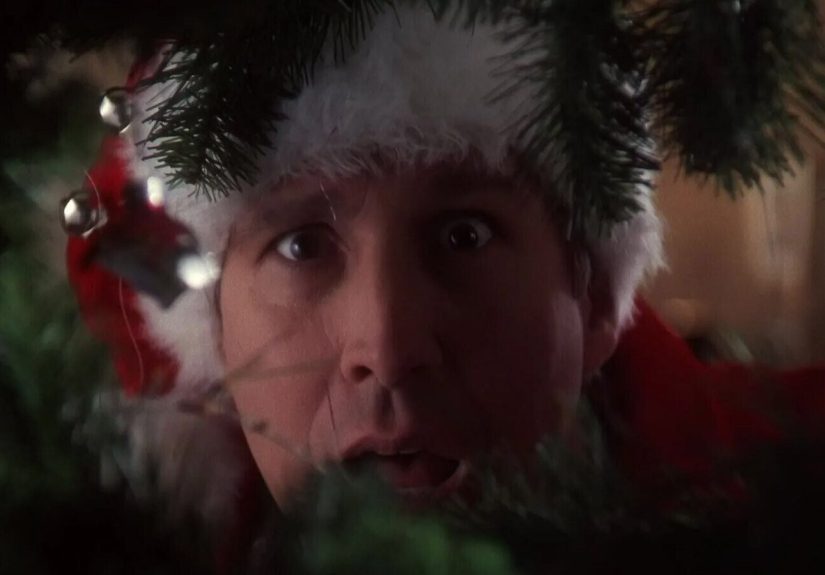
The squirrel sequence works because it arrives at exactly the right moment in Clark Griswold’s slow-motion holiday collapse. By the time the animal rockets out of the tree, the audience already knows Clark has overcommitted to the fantasy of the perfect Christmas. He has dragged home a tree the size of a small wilderness preserve, packed the house with relatives, turned outdoor decorating into an electrical event, and generally behaved like a man who believes seasonal joy can be forced into existence with enough extension cords.
Then the squirrel appears, and the movie essentially says, “Actually, Clark, nature has entered the chat.”
What follows is classic slapstick engineering. The animal tears through the house. The family panics. The dog joins the madness. Furniture loses its dignity. Chase does what he does best in physical comedy: he becomes the straight man to catastrophe while still somehow being the catastrophe’s chief architect. He does not merely react to chaos. He curates it.
That is why the scene has endured. It is not funny only because a squirrel is loose in a suburban living room. It is funny because the squirrel punctures Clark’s entire worldview in about ten seconds. The tree, the family gathering, the carefully staged holiday mood, all of it gets hijacked by a furry little agent of comic truth. The scene says what the whole movie says: Christmas is wonderful, but it is also messy, loud, unpredictable, and just one tiny surprise away from total disaster.
Chevy Chase, Clark Griswold, and Controlled Comic Meltdown
Any serious look at this story has to talk about Chevy Chase himself, because Christmas Vacation depends on his particular brand of comedy. Chase plays Clark Griswold as a man powered by ego, optimism, denial, and suburban delusion. Clark is not simply trying to create a nice holiday. He is trying to produce a legendary one, the kind that proves he is a good husband, a good father, a good son, and possibly a minor deity of outdoor lighting.
That performance style is what makes the squirrel story so irresistible in retrospect. Chase’s offscreen reputation has often been every bit as intense as his onscreen energy. Reports over the years have painted him as difficult, unpredictable, and not especially cuddly as a collaborator. Even the film’s pre-production history picked up that charge when Chris Columbus later said he exited the project after uncomfortable meetings with Chase, a turn of events that ultimately steered Columbus toward Home Alone. That bit of Hollywood butterfly-effect trivia is almost too perfect: one Christmas classic bumps awkwardly into another because Chevy Chase was being Chevy Chase.
Still, reducing Chase to only his reputation would miss the point. The movie works because he is very, very good here. Clark Griswold is exhausting, ridiculous, overconfident, petty, sentimental, and weirdly lovable. Chase knows exactly how to turn a man’s collapsing dignity into choreography. His best moments in the film are not just punchlines; they are escalating states of self-inflicted emergency.
That matters when you think about the squirrel scene. Even if parts of it required a stuffed stand-in and careful editing, the comedy still had to land through performance. Chase had to sell that the house was under attack. He had to make the panic readable, the timing sharp, and the physical business precise. A stuffed squirrel does not create movie magic by itself. It needs an actor willing to behave like his entire holiday dream has just been mugged by wildlife.
How a Messy 1989 Comedy Became a Holiday Institution
When National Lampoon’s Christmas Vacation arrived in 1989, it was not immediately treated like sacred seasonal scripture. Reviews were mixed. Some critics saw an episodic slapstick comedy with uneven pacing and a hero who was more manic than cuddly. Fair enough. Clark Griswold is not exactly a mug-of-cocoa protagonist. He is a human warning label.
But time has been very kind to this movie. Audiences kept showing up, reruns kept rolling, and the film’s quotable disasters began to feel less like random gags and more like a shared holiday vocabulary. Plenty of Christmas movies offer comfort. Christmas Vacation offers recognition. Families do bicker. Decorations do fail. Expectations do spiral into absurdity. The turkey does not always cooperate. A perfect Christmas often arrives disguised as a ridiculous one.
That is why the squirrel story lands so well today. It feels like a backstage version of the movie’s larger message. Even the making of the film was not clean, polished, and serene. It was complicated, improvised, and a little nuts. In that sense, the production story mirrors the film itself. The creators aimed for holiday magic and got there by surviving chaos.
What the Squirrel Story Reveals About Movie Magic
There is something wonderfully humbling about learning that one of cinema’s most memorable Christmas scenes depended on last-minute adjustments after a genuinely strange setback. Audiences tend to imagine iconic moments as perfectly planned. In reality, film history is full of improvisation, accidents, substitutions, and creative problem-solving. The difference between a disaster and a classic is often whether the camera was rolling when everybody figured it out.
The squirrel anecdote also reminds us how much live-animal work complicates productions. Animals are not props, and comedy timing gets much trickier when a scene depends on unpredictable movement. What looks smooth and spontaneous onscreen is usually the result of patience, planning, and a willingness to fake what cannot be safely or reliably captured in one shot. That is not a cheat. That is filmmaking. It is also why the finished scene feels more impressive the more you know about it.
And yes, there is a slightly macabre edge to all this. That is part of why the story caught fire. Christmas Vacation already lives in the sweet spot between wholesome and deranged. Learning that the squirrel sequence had such an odd production history pushes the movie even further into legend. It becomes not just a funny scene, but a tale people tell about the scene, which is how pop-culture mythology works. A classic film stops being just a film and becomes a collection of rituals, quotes, trivia, and stories people repeat every December.
The Strange, Endearing Legacy of One Tiny Scene-Stealer
In a movie packed with loud personalities, the squirrel remains one of the sharpest comic weapons in the whole arsenal. It appears, detonates the room, and vanishes into cinematic immortality. That is efficient work. Frankly, some supporting actors would kill for that kind of impact. Too soon? Probably. But Christmas Vacation has never been the delicate type.
The enduring appeal of this story is not really scandal. It is contrast. The movie is a comfort watch, yet its behind-the-scenes lore is unexpectedly chaotic. The scene feels playful, but its production history sounds like a very odd day at work. Chevy Chase’s performance feels loose, yet it took careful construction to make the moment sing. That tension between polish and pandemonium is exactly why the movie remains such a favorite.
So yes, “Working with Chevy Chase Gave the Christmas Vacation Squirrel a Heart Attack” is a sensational title. But it points toward something real: the making of this beloved holiday comedy was every bit as unpredictable as the Christmas it portrays. The squirrel story does not diminish the magic. It deepens it. It reminds us that behind every effortless laugh may be a long shoot, a backup plan, a stuffed prop, and a cast trying very hard not to lose it.
Which, when you think about it, is the most Christmas Vacation thing imaginable.
Additional Reflections and Experiences Related to the Topic
Part of what makes this behind-the-scenes story stick is that it changes the experience of watching the movie without ruining it. In fact, for many fans, it makes the scene even better. Once you know the backstory, the squirrel sequence becomes a little miracle of comic assembly. You stop seeing only the chaos in the Griswold living room and start seeing the craftsmanship behind it. You notice the way the camera catches reactions, the rhythm of the cuts, and the physical commitment in every flailing movement. The laughter is still there, but now it comes with a little admiration.
There is also something deeply relatable about how the story fits the emotional experience of the movie itself. Christmas Vacation is about trying to create perfection and being steamrolled by reality. That is not just a plot device; it is a holiday feeling almost everyone understands. You plan, decorate, schedule, shop, cook, and imagine a picture-perfect celebration. Then something goes sideways. Maybe the lights fail. Maybe the relatives arrive with extra opinions. Maybe the food goes rogue. In the Griswold universe, that “something” happens to be a squirrel in the tree, but the emotional truth is universal. The holiday never unfolds exactly as planned, and somehow that becomes the memory everyone keeps.
The Chevy Chase angle adds another layer to the experience. Chase has always been one of those performers whose talent and reputation travel together. Watching Clark Griswold now, viewers bring decades of cultural baggage to the screen. That does not erase the performance; if anything, it complicates it in a fascinating way. Clark is controlling, manic, selfish, and hilarious, yet also desperate to make everyone happy. The role feels almost custom-built for an actor who could project charm and friction at the same time. That tension gives the movie extra electricity on rewatch.
Fans also tend to love stories that reveal how close a classic came to falling apart. It is comforting in a strange way. We like to think great movies are made by confident geniuses who always know exactly what they are doing, but the truth is often messier and more human. Scenes go wrong. People improvise. Directors adapt. Actors find solutions in the moment. Props stand in for things that did not work out. The end result can still feel seamless, even if the road there looked like a holiday traffic pileup.
That may be the biggest reason this squirrel story resonates. It is funny, yes, but it also captures the lived experience of making art, hosting holidays, and generally trying to hold life together with determination and tape. You aim for elegance and get survival. You hope for peace and get slapstick. You expect a polished memory and end up with the story everyone retells for years because it was just too weird to forget. In that sense, the squirrel is not just a production anecdote. It is the unofficial mascot of every Christmas that went off the rails and still turned out unforgettable.
Conclusion
The legend of the Christmas Vacation squirrel works because it combines everything people love about the movie: behind-the-scenes weirdness, comic disaster, Chevy Chase mythology, and the strange comfort of knowing that holiday magic often arrives looking like total confusion. The real production story is less a scandal than a reminder that enduring comedy is usually built the hard way. A trained animal was lost, a replacement was used, a prop filled in, and the cast still delivered one of the most unforgettable scenes in Christmas movie history. Decades later, the laughter remains, the trivia keeps growing, and the squirrel still steals the tree, the room, and the conversation.